
The Hydration Index: Why Water Isn’t the Ultimate Hydrator
By Mackenzie Suggs, M.S.
We have all been given the same foundational wellness advice: drink eight glasses of plain water a day to stay perfectly hydrated. But what if the science of hydration is more nuanced than just tracking your daily fluid volume?
In 2016, a groundbreaking study published in The American Journal of Clinical Nutrition flipped conventional wisdom on its head. A team of researchers led by Professor Ronald Maughan introduced a concept known as the Beverage Hydration Index (BHI). Their findings revealed that while water is an excellent, zero-calorie option, several common beverages actually keep your body hydrated for longer periods than plain water.
What is the Beverage Hydration Index?
Much like the Glycemic Index measures how quickly carbohydrates raise blood sugar, the Beverage Hydration Index (BHI) quantifies how long a specific fluid remains inside the body before being excreted in urine.
To establish the index, researchers tracked 72 healthy, fasted men who consumed 1 liter of still water. The amount of fluid retained in their bodies over a subsequent four-hour period was assigned a baseline value of 1.0. The researchers then tested 12 other common beverages under identical conditions.
A BHI score of 1.0 means a drink hydrates you exactly like plain water.
A BHI score greater than 1.0 means the body retains more fluid over time, reducing trips to the bathroom.
A BHI score below 1.0 means the beverage triggers a higher rate of fluid excretion.
The Hydration Leaderboard
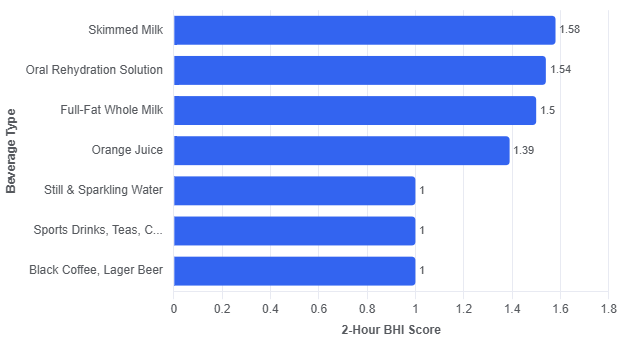
The study’s results challenged popular expectations. Several nutrient-dense beverages significantly outperformed water when it came to long-term fluid retention:
The Biology Behind the Scores
Why did beverages like milk and oral rehydration solutions secure scores around 1.5, meaning they allowed participants to retain roughly 50% more fluid than plain water two hours post-consumption? The secret lies in three physiological mechanisms:
1. Gastric Emptying Rate
Plain water passes through the stomach and enters the bloodstream incredibly fast. While great for rapid rehydration, a sudden influx of fluid dilutes the bloodstream and triggers a rapid renal response essentially signaling your kidneys to flush out the excess water. Beverages containing macronutrients (such as the protein, fat, and lactose in milk) slow down stomach emptying. This ensures a slower, more sustained release of fluids into the intestines for absorption.
2. The Power of Electrolytes
Sodium and potassium act like biological sponges. Sodium is the primary extracellular electrolyte responsible for retaining water in bodily tissues. Oral rehydration solutions and milk naturally boast high concentrations of electrolytes, which actively prevent the kidneys from producing excess urine.
3. The Myth of the Coffee Crash
Many people assume that morning coffee or afternoon tea leaves them severely dehydrated due to caffeine's diuretic properties. However, Maughan’s team discovered that the volume of water present in standard servings of coffee, tea, and even low-alcohol beer is more than enough to offset the minor fluid loss caused by caffeine or alcohol at normal doses.
How to Apply BHI to Your Daily Routine
While water should remain your primary, daily calorie-free baseline, understanding BHI can transform how you approach specific scenarios:
For Post-Workout Recovery: If you have just completed a grueling sweat session, reaching for skimmed or low-fat milk can replenish muscle-repairing proteins while anchoring essential fluids and electrolytes in your system longer than regular water.
For Long Travel or Meetings: If you face a long flight, a lengthy road trip, or back-to-back presentations where frequent bathroom breaks are inconvenient, sipping on an electrolyte-infused beverage or a small glass of juice can maximize your fluid retention.
For Acute Dehydration: In cases of illness-induced dehydration, standard water isn't enough. An Oral Rehydration Solution (ORS) is specifically balanced with glucose and sodium to optimize immediate cell-level absorption.
References
Maughan, R. J., Watson, P., Cordery, P. A., et al. (2016). A randomized trial to assess the potential of different beverages to affect hydration status: development of a beverage hydration index. The American Journal of Clinical Nutrition, 103(3), 717–723. PubMed Link.
Campagnolo, A., et al. (2021). The Beverage Hydration Index: Influence of Electrolytes, Carbohydrate and Protein. Nutrients, 13(9), 2933. PMC Link.
Adams, W. M., et al. (2019). A randomized trial to assess beverage hydration index in healthy older adults. The American Journal of Clinical Nutrition, 109(5), 1321–1327. ScienceDirect Link.
