
By Mackenzie Suggs, M.S.
For decades, dietary fat was labeled the ultimate health villain. Supermarket shelves filled up with "low-fat" and "fat-free" boxes, convincing everyone that eating fat was a one-way ticket to gaining weight.
But here is the truth: dietary fat does not make you fat, and your body completely depends on it to survive.
When you strip fat out of your diet, you miss out on essential nutrients, disrupt your hormones, and usually end up replacing those calories with processed sugars that cause energy crashes. Let’s pull back the curtain, break down the basic science, and look at how to use this powerful macronutrient to fuel your body.
What is Fat and Why Do You Need It?
Fat is one of the three primary macronutrients your body needs in large amounts every day, alongside protein and carbohydrates. On a chemical level, dietary fats provide 9 calories per gram making them more than twice as energy-dense as proteins or carbs, which only provide 4 calories per gram.
Because it is so dense, fat is your body's ultimate slow-burning energy reserve. Beyond keeping you fueled, fat plays several non-negotiable roles in your body:
Vitamin Absorption: The essential fat-soluble vitamins like Vitamins A, D, E, and K cannot be absorbed by your gut without dietary fat present.
Hormone Production: Fat serves as the structural building block for vital reproductive and metabolic hormones.
Brain Health: Your brain is actually composed of roughly 60% fat, meaning healthy fats directly support cognitive function and mood regulation.
Satiety and Fullness: Fat triggers the release of fullness signals, slowing down your digestion so you stay satisfied long after a meal.
The Big Myth: Why Eating Fat Doesn’t Make You Fat
It sounds logical on the surface: if you eat fat, it turns into body fat. But human metabolism doesn't work that way.
Body fat storage is primarily driven by an energy surplus (eating more total calories than your body burns over time), combined with hormonal imbalances like insulin resistance (inability to use insulin properly). Your body can store excess calories as fat whether those calories come from a surplus of carbohydrates, proteins, or fats.
In fact, eating healthy fats can actually support weight management. Because fat digests slowly, it keeps your blood sugar stable and prevents the sharp insulin spikes and subsequent crashes that leave you craving quick, processed carbs or feeling fatigued later in the day.
Your Quick Reference Guide to Dietary Fats
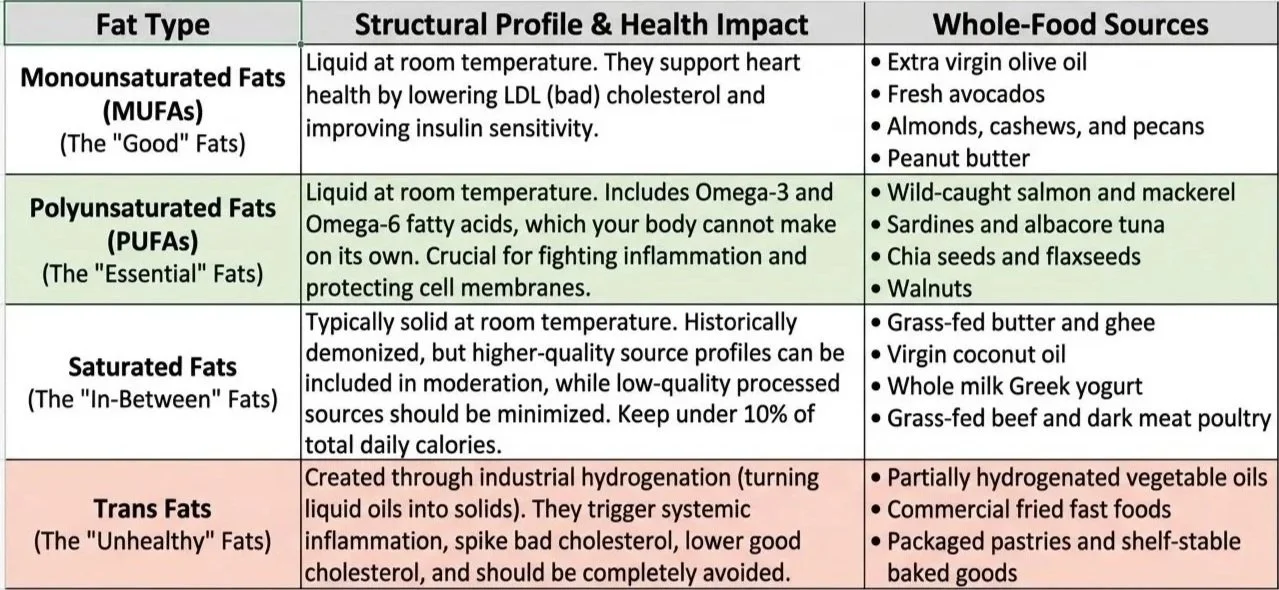
Not all fats are created equal. The health impact of a fat comes down to its chemical structure. This chart explains the difference between each type of fat, how they impact our health, and some food sources:
How to Calculate Your Daily Fat Intake
Determining your optimal daily fat target is straightforward and can be customized based on your overall energy needs. According to the Dietary Guidelines for Americans, dietary fat should account for 20% to 35% of your total daily calorie intake.
To calculate your exact personal gram target:
Identify your total daily calorie target based on your activity level and fitness goals.
Determine your fat calorie budget using the 20% to 35% baseline framework.
Divide that number by 9 (since there are 9 calories in every single gram of fat).
Example Math Profiles:
Example Calculations:
For a 1,800-calorie diet (at 25% fat):
1,800 × 0.25 = 450 calories from fat
450 ÷ 9 = 50 grams of fat per day
For a 2,400-calorie diet (at 30% fat):
2,400 × 0.30 = 720 calories from fat
720 ÷ 9 = 80 grams of fat per day
Don't fear the fat on your plate. Instead, focus your grocery list on high-quality, whole-food fats like fresh avocados, raw nuts, seeds, and wild-caught fatty fish. Keep your automated processed fats to an absolute minimum, align your total grams with your training demands, and let this powerful macronutrient work for your performance and healthspan, not against it.
Frequently Asked Questions About Dietary Fat
What types of fats should I prioritize for optimal health?
Instead of focusing on just one "superfood," the healthiest approach is to prioritize a variety of whole-food unsaturated fats. Extra virgin olive oil, fresh avocados, raw nuts (like walnuts and almonds), and seeds (like chia and flax) are the true gold standards. These whole foods are packed with monounsaturated and polyunsaturated fats that protect your heart, support your brain, and naturally lower inflammation. Plus, they come naturally loaded with essential fiber and critical micronutrients (vitamins and minerals) like Vitamin E for cellular protection and magnesium for metabolic health that you simply cannot get from refined industrial oils.
What are the best overall whole-food fat sources?
To get a robust mix of essential fatty acids and fat-soluble vitamins, focus your grocery cart on these primary whole foods:
Avocados (excellent for fiber and monounsaturated fats)
Wild-caught fatty fish like salmon, sardines, and mackerel (the absolute best sources of anti-inflammatory Omega-3s)
Raw nuts and seeds such as walnuts, almonds, chia seeds, and flaxseeds
Whole eggs and full-fat Greek yogurt (both protein and high-quality fats)
Does eating fat before bed help with sleep or fat loss?
Eating a small amount of healthy fat before bed can help stabilize your blood sugar throughout the night, which stops midnight waking caused by blood sugar drops. Because fat digests slowly, it keeps you full, but it doesn't directly burn body fat on its own total daily energy balance is still what dictates overall weight management.
Can a low-fat diet cause brain fog or low energy?
Absolutely. Your brain is composed of roughly 60% fat, and your cell membranes depend on lipids to communicate efficiently. Dropping your dietary fat intake too low can impair cognitive function, cause midday energy crashes, and disrupt hormones, leaving you feeling sluggish, moody, and chronically hungry.
Is coconut oil actually healthy or should I avoid it?
Coconut oil is primarily a saturated fat, but it contains a high concentration of Medium-Chain Triglycerides (MCTs). Your liver processes MCTs rapidly for quick energy rather than storing them. It is perfectly healthy to include in your cooking rotation, but it shouldn't completely replace your primary unsaturated fats like extra virgin olive oil.
References
U.S. Department of Agriculture and U.S. Department of Health and Human Services. Dietary Guidelines for Americans, 2025–2030. 10th Edition.
Chang, C. Y., Ke, D. S., & Chien, B. L. (2009). Essential fatty acids and human brain. Acta Neurologica Taiwanica, 18(4), 231-241.
Mensink, R. P., Zock, P. L., Kester, A. D., & Katan, M. B. (2003). Effects of dietary fatty acids and carbohydrates on the ratio of serum total to HDL cholesterol and on serum lipids and apolipoproteins: a meta-analysis of 60 controlled trials. The American Journal of Clinical Nutrition, 77(5), 1146-1155.
Mozaffarian, D., Katan, M. B., Ascherio, A., Stampfer, M. J., & Willett, W. C. (2006). Trans fatty acids and cardiovascular disease. New England Journal of Medicine, 354(15), 1601-1613.
Gannon, M. C., Nuttall, F. Q., Damberg, G., Gupta, V., & Hoover, H. (2001). Effect of a high-fat diet on satiety and metabolic markers. Journal of Clinical Endocrinology & Metabolism, 86(3), 1012-1017.
