
By Mackenzie Suggs, M.S.
When you can't or choose not to consume dairy, you are forced past the standard whey options into a crowded marketplace flooded with competing claims. Unfortunately, because non-dairy sources like peas or hemp have a naturally earthy, chalky, or acquired taste profile, commercial brands rely on heavy processed formulation to mask the taste and texture of these powders. The result is a market full of non-dairy protein powders packed with artificial chemicals, flavors, colors, and preservatives.
Finding an alternative protein that respects your digestion and your health shouldn't mean compromising on ingredient purity and quality. When you strip away the flashy branding and the defensive labeling, the choices become simple.
Here is the evidence-based reality of how alternative proteins stack up, how their manufacturing processes differ, and how to find a clean source that truly aligns with your body's specific operational needs.
Pea Protein: The Plant-Based Alternative
Pea protein isolate is extracted from yellow split peas and stands as the most popular plant-based option on the market.
How it differs: It is naturally free from common allergens like dairy, gluten, and soy. While it contains all 9 essential amino acids required for recovery, it is relatively low in the amino acid methionine.
Who it is for: Individuals following a vegan or vegetarian lifestyle, or those with severe lactose or dairy intolerances who want a clean, plant-based recovery option.
Egg White Isolate: The Bioavailable Dairy-Free Option
Egg white protein is made by removing the yolks from whole eggs and dehydrating the remaining pure albumin into a fine powder.
How it differs: It is a highly bioavailable, complete protein with a high leucine content, completely free from dairy and lactose. It digests at a moderate rate, sitting perfectly between fast-digesting whey and slow-digesting casein.
Who it is for: Athletes who want premium muscle-building results comparable to whey but must avoid dairy due to allergies or strict Paleo dietary guidelines.
Collagen Peptides: The Structural Specialist
Collagen is derived from the connective tissues, hides, or bones of bovine or marine sources.
How it differs: Collagen is an incomplete protein. It completely lacks the essential amino acid tryptophan and is very low in branched-chain amino acids (BCAAs). However, it is exceptionally dense in specific amino acids—glycine, proline, and hydroxyproline which are the primary building blocks for structural tissues.
Who it is for: Individuals prioritizing joint health, tendon recovery, skin elasticity, and connective tissue strength. Because it lacks a complete amino acid profile, it should not be used as a primary post-workout recovery source for muscle building or meal replacement.
Bone Broth Protein: The Gut-Friendly Choice
Bone broth protein is made by simmering animal bones and connective tissue into a nutrient-dense liquid, which is then dehydrated into a concentrated powder.
How it differs: Similar to collagen, it is rich in glycine and glutamine. It contains naturally occurring gelatin and minerals that support the integrity of the intestinal lining, making it incredibly easy on highly sensitive stomachs.
Who it is for: Individuals focusing on gut health protocols (such as addressing leaky gut or IBS), those following an ancestral or Paleo framework, or anyone who experiences severe digestive upset from highly processed dairy or plant powders.
Maximizing Alternative Proteins: The Amino Acid Deficit & Biological Rating
Unlike whey or milk proteins which are naturally "complete" with high concentrations of essential amino acids (EAAs)—most plant-based alternative proteins are limited by their amino acid profiles, reducing their overall biological quality.
To understand how efficiently your body can use an alternative protein to build new structural or functional proteins, we look at its Biological Value (BV) and its Digestible Indispensable Amino Acid Score (DIAAS). A score of 100 or 1.0+ means the protein perfectly meets human requirements and is absorbed completely.
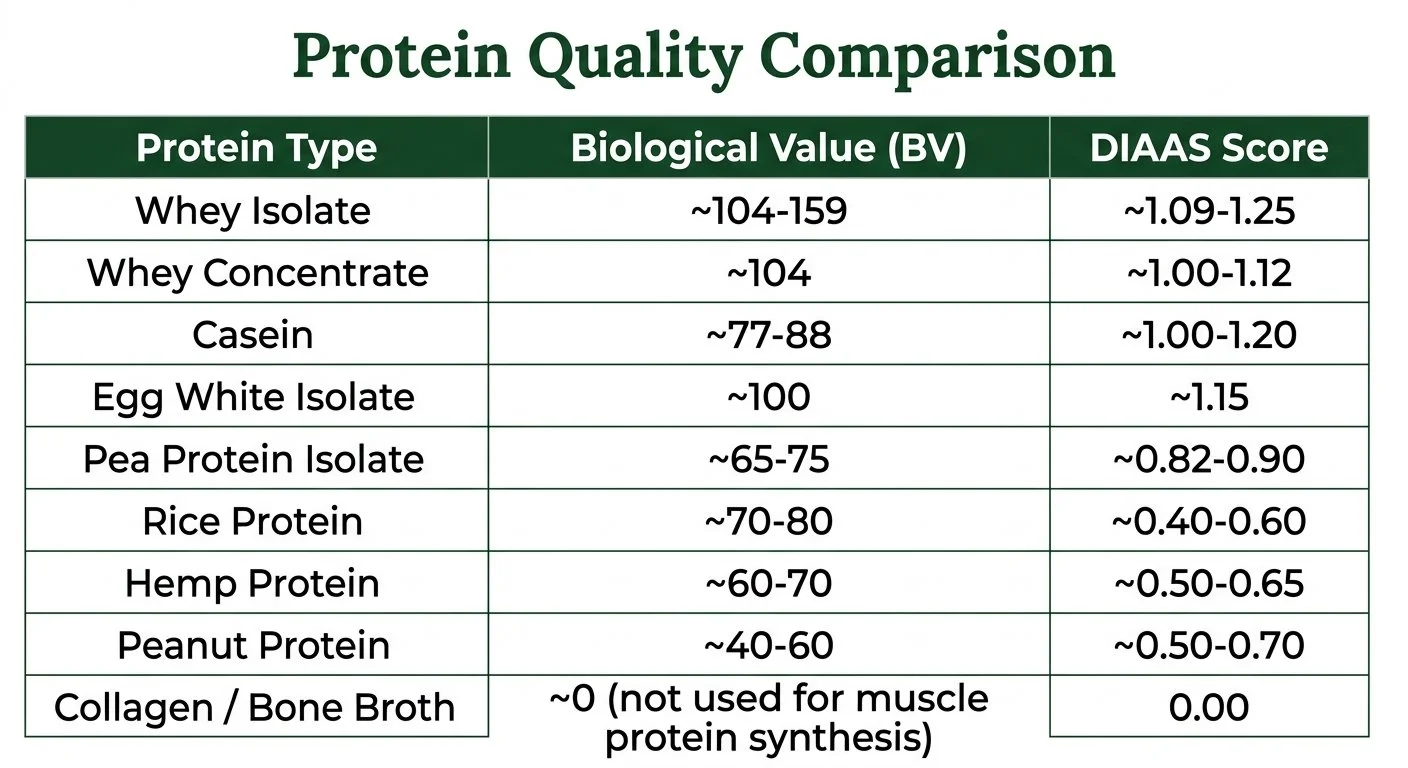
Biological Quality & Retention Rankings
The body uses alternative protein sources with varying degrees of efficiency based on their amino acid completeness and natural anti-nutrients (like phytates), which can block absorption.
Egg White Isolate (Gold Standard Non-Dairy): Carries a Biological Value of 100 and a DIAAS of 1.15. It is fully complete, highly bioavailable, and the most efficient non-dairy source for synthesizing new tissue.
Pea Protein Isolate (Premium Plant): Carries a Biological Value of 65–75 and a DIAAS of 0.82–0.90. While it is an excellent plant source, it is a "limiting protein" because it is naturally low in the essential amino acid methionine.
Collagen & Bone Broth (Structural Specialist): Carries a Biological Value of 0 for muscle building and a DIAAS of 0.00. Because it entirely lacks the essential amino acid tryptophan, the body cannot use it by itself to synthesize new muscle tissue. Instead, it is immediately routed to repair connective tissues using its rich pool of glycine and proline.
3 Science-Backed Strategies to "Complete" Alternative Proteins
If you rely on plant or alternative sources, you can easily trick your biology into utilizing them just as efficiently as whey by applying three rules of protein synthesis:
Practice Protein Complementarity (The Pairing Trick): If a plant protein is low in one specific amino acid, you must pair it with a source that excels in it. Pea protein is high in lysine but low in methionine. Rice protein or hemp protein is low in lysine but exceptionally rich in methionine. By mixing pea and rice protein together, you create a complete amino acid profile that mimics the exact biological efficiency of a dairy protein.
Compensate with Total Volume (Overcoming the Leucine Threshold): Muscle Protein Synthesis (MPS) requires a specific trigger amount of the branched-chain amino acid leucine (usually 2.5 to 3 grams per serving). While you can hit this threshold with just 25 grams of whey isolate, you might only get 1.6 grams of leucine from 25 grams of pea protein. Consuming 35 to 40 grams of a plant isolate ensures you clear the leucine threshold, prompting your body to initiate full protein building.
Use Structural Proteins as "Boosters," Not Bases: Never count your collagen or bone broth powder toward your daily muscle-building protein targets. Instead, treat them as structural boosters. If you take a collagen supplement for your joints or skin, consume it alongside a small dose of a complete protein (like egg white or pea/rice blends) or a whole-food meal. Providing the missing tryptophan allows your body to fully utilize all the amino acids seamlessly.
How to Select the Right Source for Your Goals
You don't need a complex rubric to find a premium supplement. When choosing a non-dairy option, follow these three simple steps:
Step 1: Align the Source with Your Primary Goal
If your primary goal is muscle repair, lean mass retention, or metabolic satiety, prioritize Egg White Isolate or Pea Isolate.
If your goal is joint comfort, tendon recovery, skin health, or gut lining support, look toward Collagen or Bone Broth.
Step 2: Read the Ingredient List (Watch for Fluff)
Because alternative proteins (especially plant-based options) can have a naturally bitter or earthy flavor, manufacturers frequently overload them with fillers. Turn the tub around and check the "Other Ingredients" section. Avoid products packed with thick chemical gums (xanthan, guar, carrageenan), hydrogenated oils, or lengthy lists of artificial sweeteners. Look for minimal additions like organic cocoa, organic stevia, or monk fruit.
Step 3: Look for Third-Party Testing
Because dietary supplements are not tightly regulated before they hit shelves, look for an independent stamp of approval. Seals from NSF Certified for Sport, Informed-Choice, or Labdoor guarantee that what is written on the container is exactly what is inside the powder, ensuring it is completely free from heavy metals, contaminants, and unlisted fillers.
References
Gorissen, S. H., et al. Protein content and amino acid composition of commercially available plant-based protein isolates. PubMed
Khatri, M., et al. The effects of collagen peptide supplementation on body composition, collagen synthesis, and recovery from joint injury and exercise: a systematic review. PubMed
FAO/WHO Expert Consultation. Dietary protein quality evaluation in human nutrition. Food and Agriculture Organization (FAO)
