
By Mackenzie Suggs, M.S.
We’ve all been there. You look at a grueling 60-minute workout video or stare down a long, exhausting run and think, “There is no way I have the time or energy for this today.”
If you’ve ever felt like getting healthy requires transforming into a full-time gym rat, I have some incredible, science-backed news for you. You don’t need to live in the weight room to completely change your health. In fact, when it comes to movement, the "perfect" amount might be a lot less and a lot more flexible than you think.
Let’s dive into what the latest scientific research says about the minimum amount of exercise to protect your health, the absolute "sweet spot" for longevity, and where moving too much might actually start pushing back.
The Bare Minimum: How Much is "Enough"?
If you are short on time, stressed, or just starting out, this is your permission slip to breathe a sigh of relief. You do not need to work out for hours to reap massive benefits. Scientists call this finding the minimum effective dose, the smallest amount of effort required to get a positive result.
The Baseline Standard
Major health organizations like the World Health Organization (WHO) recommend a baseline of 150 to 300 minutes of moderate activity (like a brisk walk) or 75 to 150 minutes of vigorous activity (like running or a spin class) every single week. They also recommend doing some form of muscle-strengthening work on 2 or more days.
But what if you can't even hit that? Incredible new research shows that even tiny, spontaneous bursts of movement throughout your day make a massive difference.
Scientists call this VILPA, which stands for Vigorous Intermittent Lifestyle Physical Activity. Think of these as "exercise snacks": speed-walking up the stairs, sprinting to catch a bus, or vigorously vacuuming the living room for two minutes. A landmark study published in JAMA Oncology found that just 3 to 4 minutes of these quick, daily bursts can dramatically lower your risk of early death and chronic diseases.
The Strength Minimum
The same rule applies to lifting weights. A large review published in the British Journal of Sports Medicine found that just 30 to 60 minutes of total strength training per week drops your risk of early death by 10% to 20%. You don't need split routines five days a week; a single focused full-body session or two short ones is enough to move the needle.
The Longevity Sweet Spot: The Maximum Benefit
If you already have a solid routine and want to optimize your body for the long haul, you might want to scale up from the bare minimum. There is a specific zone where your health benefits peak.
The 2x to 4x Rule
A massive, 30-year study tracking over 116,000 adults looked at what happens when people go above and beyond the standard recommendations. The researchers found that people who did 300 to 600 minutes of moderate exercise (or 150 to 300 minutes of vigorous exercise) per week enjoyed the absolute lowest rates of early death—slashing their risk by up to 31%.
If your primary goal is protecting your ticker, a study in the British Journal of Sports Medicine showed that aiming for about 9 to 10 hours a week of mixed movement provides a staggering 30% reduction in heart attacks and strokes.
The secret sauce isn't just doing more of the same thing; it’s variety. A fascinating study tracked 110,000 people and discovered that exercise variety is a major secret to longevity. People who mixed up their routines (combining cardio, strength work, and flexibility) had a 19% lower risk of dying over a 30-year period compared to people who did the exact same total volume of just one type of exercise.
The Upper Limit: Can You Do Too Much?
In the health world, there is a concept called the Extreme Exercise Hypothesis. It's the scientific way of asking: Can a good thing turn bad if you do way too much of it? The answer is yes, but it mostly applies to elite or ultra-endurance athletes.
The Plateau Effect
A massive analysis of over 660,000 people published in JAMA Internal Medicine found that the health benefits of exercise eventually hit a ceiling. Once you pass about 7.5 hours of moderate exercise a week, the extra benefits flatline. Adding more hours won't necessarily hurt you, but it stops giving you extra "life points."
For folks who take it to the absolute limit like ultra-marathoners or long-distance triathletes scientists have noticed a strange paradox. Studies show that these extreme athletes sometimes have higher rates of coronary artery calcification (calcium and plaque buildup inside the arteries).
Systemic Overtraining
For the everyday exerciser, the real risk of pushing past 90 minutes a day without enough food or rest is systemic overtraining syndrome.
When you don't give your body a break, your nervous system gets exhausted. Instead of getting stronger, you experience chronic fatigue, a weaker immune system (meaning you catch every cold going around), disrupted sleep, and nagging injuries. Your body simply cannot repair its tissues as fast as you are breaking them down.
Visualizing the Sweet Spot: The Exercise Curve
To easily see how your weekly movement translates to health benefits, check out the data plotted on this exercise dose-response curve:
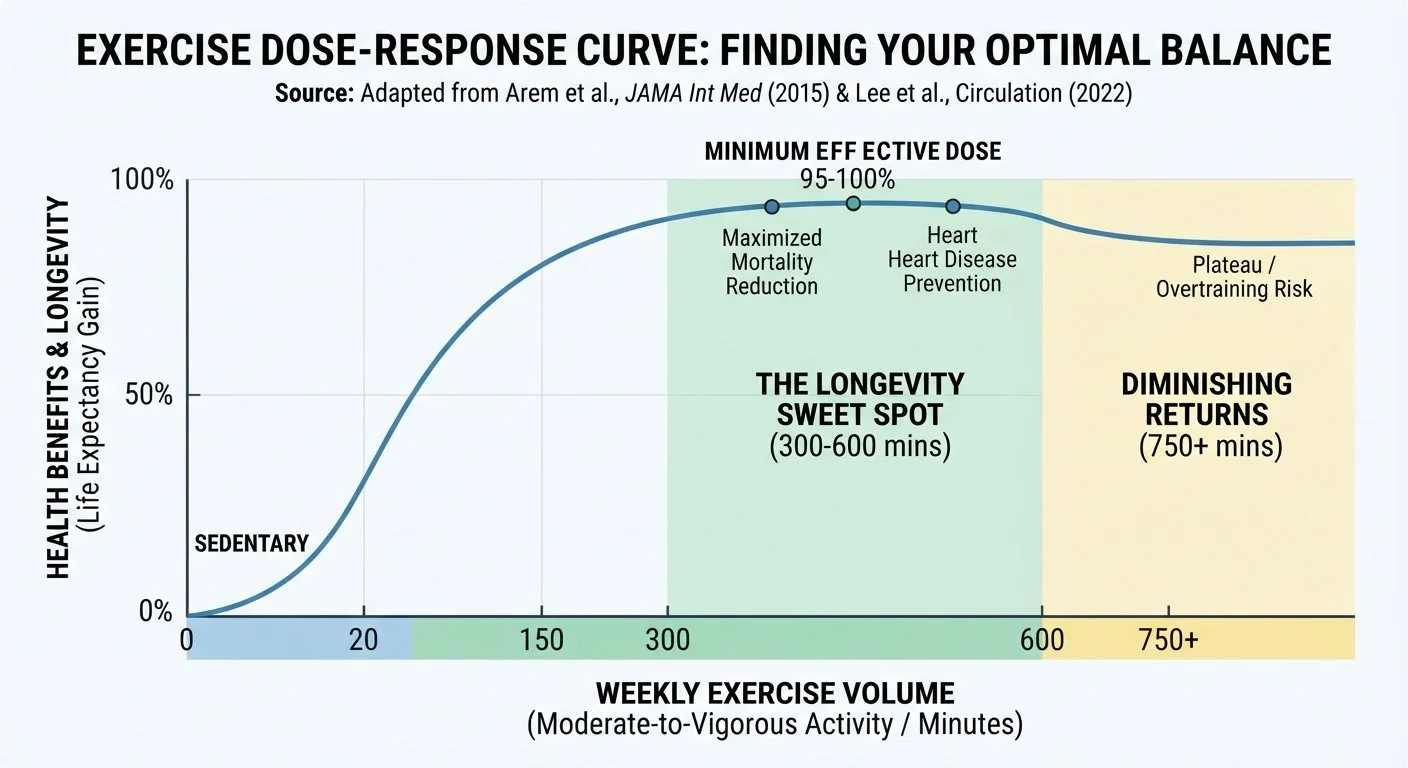
As you can see, the biggest jump in benefits happens right at the beginning when you move away from being sedentary. From there, you coast smoothly into the green optimal zone before benefits eventually level off.
"Wait, 300 Minutes Sounds Like a Lot!"
If you just gasped at the idea of tracking 300 minutes of exercise, take a deep breath. It doesn't mean 300 minutes of grueling gym workouts. It includes your normal, everyday daily life movement, walking, and lifting.
To make this practical, let's break down exactly what counts as "moderate" versus "vigorous" activity using simple everyday rules:
Moderate Activity (The "Can't Sing" Rule): Your heart rate is up, and you can comfortably talk in full sentences, but you cannot sing without losing your breath. This includes brisk walking (around 3 mph), pushing a lawnmower, leisurely bike riding, or active house cleaning.
Vigorous Activity (The "Few Words" Rule): You can only say a few words at a time before needing to pause for a breath. This includes running, high-intensity interval training (HIIT), fast swimming, or heavy lifting circuits.
The "Double Value" Shortcut: In clinical research, 1 minute of vigorous activity counts as 2 minutes of moderate activity. If your goal is 300 minutes of moderate activity, you can achieve the exact same health benefits by doing just 150 minutes of vigorous activity instead!
Understanding How to Break Up 300 Minutes
Let’s look at a real-world routine to see how fast these minutes add up: aiming for 10,000 steps a day (6 days a week) and hitting 4 weight training sessions a week.
Walking 10k steps naturally takes about 80–90 minutes of total moving across the whole day. If you multiply that across 6 days, you’ve already logged over 480 minutes of moderate movement! Toss in your 4 strength training sessions, and you are easily clearing 600+ minutes of high-yield activity per week. You hit the absolute peak of the longevity curve without ever having to step foot into more cardio or high energy taxing HIIT workouts (not that these are not useful).
Your Action Plan: Choosing Your Path Based on Your Goals
The biggest mistake people make with fitness data is trying to do everything at once or doing whatever the latest fitness trend is. You don’t need a generic protocol. You need an approach tailored to your specific schedule, energy levels, and personal health goals. Use one of these three blueprints as a baseline guide to your goal:
Blueprint 1: The Minimum Effective Plan for Beginners or Busy Go Getters
Best For: Individuals facing extreme time constraints, high stress, or those transitioning away from a completely sedentary lifestyle.
The Weekly Target: 75 to 150 minutes of high-yield movement.
The Action Steps:
Utilize Exercise Snacks: Sprinkle three 2-minute bursts of vigorous movement (like climbing stairs quickly) throughout your workday.
Condense Your Training: Perform two focused, 20-minute time-efficient home strength circuits per week.
Walk Briskly: Take a sharp, 15-minute walk outside directly after your largest meal of the day.
Blueprint 2: Ready to Maximize Longevity and Health
Best For: Individuals looking to minimize disease risk, protect their heart, and optimize long-term healthspan.
The Weekly Target: 300 to 500 minutes of total mixed movement.
The Action Steps:
Track Your Steps: Aim for 8,000 to 10,000 steps per day, 5 to 6 days a week.
Add Baseline Strength: Complete two 30-minute full-body resistance training sessions per week.
Keep It Casual: Count active commuting, brisk dog walks, and intense yard work toward your total.
Blueprint 3: Interested in Building More Muscle but also Improving Your Healthspan
Best For: Individuals aiming to gain functional strength, build dense muscle, and support metabolic health.
The Weekly Target: 400 to 600 minutes of total movement, emphasizing resistance training.
The Action Steps:
Prioritize Lifting: Complete four to five 45-to-60-minute weight training sessions per week.
Maintain an Active Baseline: Aim for 8,000 to 10,000 steps per day to preserve cardiovascular health.
Incorporate Rest: Ensure you take 1 to 3 days completely off from heavy lifting to allow your tissues to fully recover.
At the end of the day, the best exercise routine is the one you actually enjoy and can stick with long-term. Listen to your body, choose the blueprint that matches your current season of life, and remember that no matter what you pick its a step closer to your goals!
-
Arem, H., Moore, S. C., Patel, A., Hartge, P., Berrington de Gonzalez, A., Visvanathan, K., Campbell, P. T., Freedman, M., Weiderpass, E., Adami, H. O., Linet, M. S., Schairer, C., Vogel, J. R., & Matthews, C. E. (2015). Leisure time physical activity and mortality: A detailed pooled analysis of the dose-response relationship. JAMA Internal Medicine, 175(6), 959–967. doi.org
Lee, D. H., Rezende, L. F. M., Joh, H. K., Keum, N., Ferrari, G., Rey-Lopez, J. P., Rimm, E. B., Tabung, F. K., & Giovannucci, E. L. (2022). Long-term leisure-time physical activity intensity and all-cause and cause-specific mortality: A prospective cohort of US adults. Circulation, 146(7), 523–534. doi.org
Momma, H., Kawakami, R., Honda, T., & Sawada, S. S. (2022). Muscle-strengthening activities are associated with lower risk and mortality in major non-communicable diseases: A systematic review and meta-analysis of cohort studies. British Journal of Sports Medicine, 56(13), 755–763. bmj.com
Stamatakis, E., Ahmadi, M. N., Friedenreich, C. M., Blodgett, J. M., Donnelly, J. E., Thøgersen-Ntoumani, C., Gerber, M., Schulz, K. H., Gasevic, D., Johnson, N. A., & Hamer, M. (2023). Vigorous intermittent lifestyle physical activity and cancer incidence among nonexercisers: The UK Biobank Accelerometry Study. JAMA Oncology, 9(9), 1211–1219. doi.org
U.S. Department of Health and Human Services. (2018). Physical activity guidelines for Americans (2nd ed.). health.gov
